AI adoption numbers are rising quickly, but tool ownership is not the same as business value. The Office for National Statistics reported that AI use among UK businesses with 10 or more employees grew from around 12% in late 2023 to around 35% by June 2026. Yet adoption remained relatively shallow: the average number of AI technologies used by adopting businesses moved only from about 1.4 to 1.6, and just 10% described their use as extensive.
That is not a verdict against AI. It is a clue about the next stage.
UK government research found that 75% of adopters reported improved workforce productivity and 57% reported improved processes. But only 12% had seen revenue increase, while 77% reported no revenue change. An OECD survey of more than 5,000 SMEs found a similar pattern: 65% of generative-AI users reported better employee performance, compared with 26% reporting increased revenue.
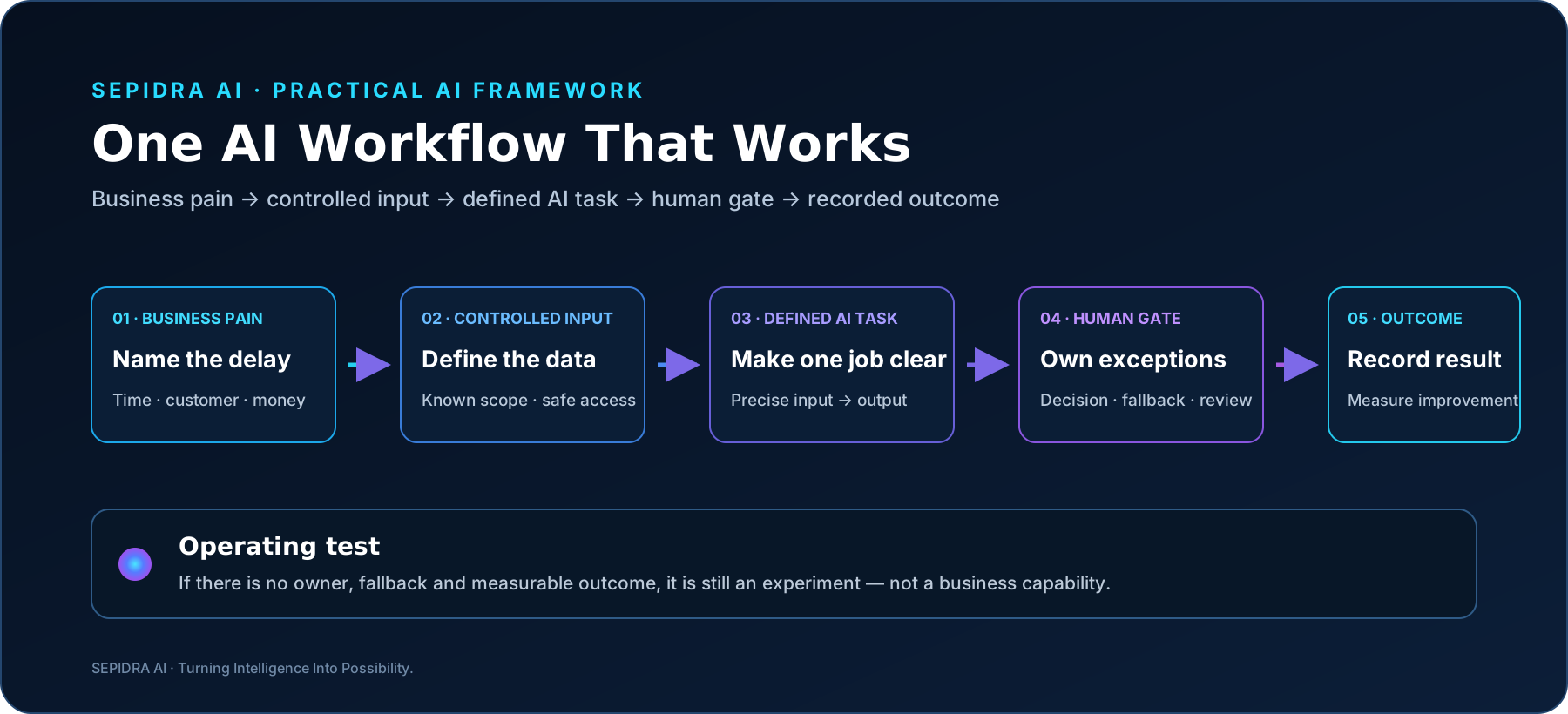
Start with a recurring problem close to time, customer experience or money—missed enquiries, slow quote follow-up, scheduling friction, repetitive intake or overdue invoices. Then design five connected parts: the business pain, controlled inputs, a precise AI task, a human decision gate and a recorded outcome.
If the task cannot be named precisely, there is no owner for exceptions, no fallback when the system is uncertain and no result being measured, it is still an experiment—not a business capability.
Eurostat’s 2026 digitalisation review shows the adoption gap clearly: in 2025, 19% of EU SMEs used AI, compared with 55% of large businesses. Small firms can turn that gap into an advantage. They often have fewer legacy systems, shorter decision paths and a clearer view of everyday friction.
The best first AI workflow may look boring in a demonstration. What matters is whether people use it on Monday morning, whether it records what happened and whether a meaningful result improves.
Do not begin by asking, “Which AI are we using?” Ask, “Which business delay will no longer exist, who owns failure and how will we prove improvement?” Tools will change quickly. A reliable operating pattern can outlast them.
Sources
- Office for National Statistics — Artificial intelligence in UK businesses: 2023 to 2026
- UK Government — AI Adoption Research
- OECD — Generative AI and the SME Workforce
- UK Government — AI Champions’ Adoption Plans: Summaries
- Eurostat — Digitalisation in Europe, 2026 edition
Editorial note: the five-stage workflow model and recommendations above are SEPIDRA’s original synthesis of the cited evidence.